> For the complete documentation index, see [llms.txt](https://docs.dataloy.com/llms.txt). Markdown versions of documentation pages are available by appending `.md` to page URLs; this page is available as [Markdown](https://docs.dataloy.com/dataloy-distance-table-ddt/routing-and-routing-options.md).
# Routing and routing options
The routes in Dataloy Distances are, by default, the shortest route viable for a commercial ship. As ships have varying sizes, route customisation is essential to get the most accurate route for your needs.
The routes can be customised by adding additional ports, routing points, and canals. It is also possible to add [points using latitude and longitudes](/dataloy-distance-table-ddt/custom-point-using-latitude-and-longitude.md) of your choice.
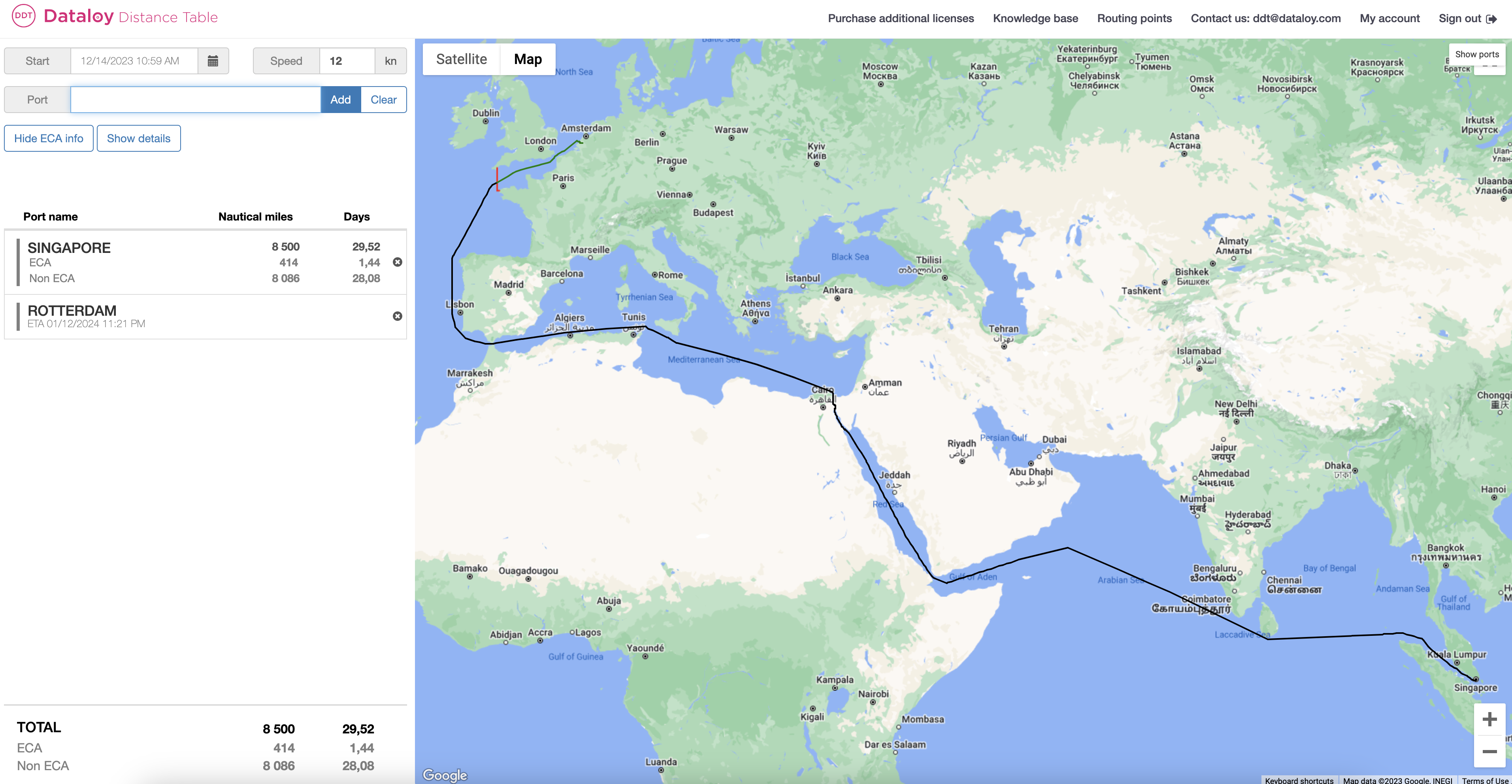
Default route via Suez Canal
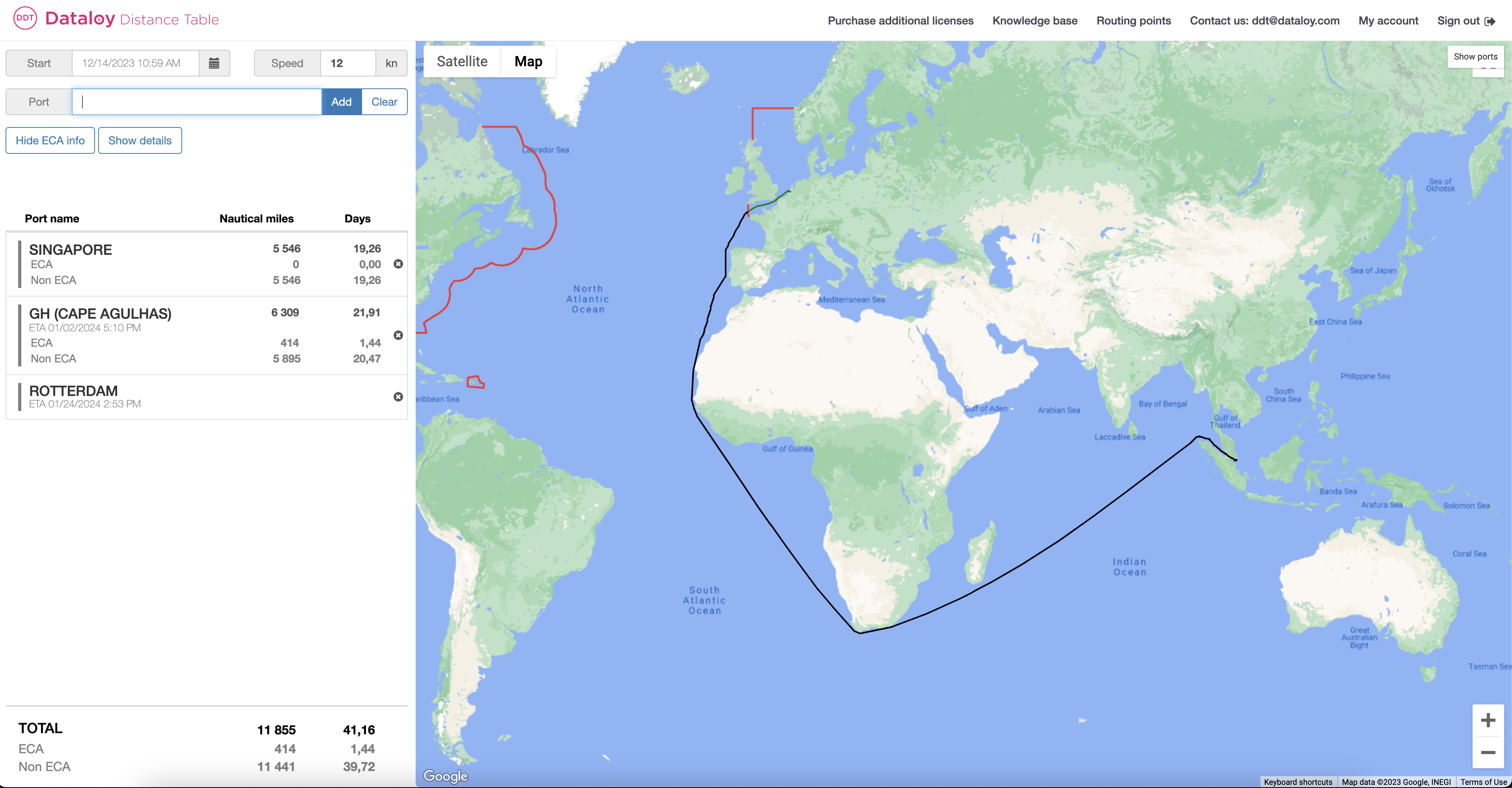
Customised route via Cape Agulhas
**To Search for/Add a Routing Point/Port**
1. Routing point searches can be performed in two ways: in the search field or by using a map.
2. Click the "**Show Ports" button** to show all routing points/ports on the map.\
The ports will show according to zoom level, so you might need to zoom in to display smaller ports. \
\
\
3. Locate the applicable **routing point** on the map.
4. Click on or hover over (with the cursor) the applicable **routing point symbol**\
.
5. An information pop-up opens, providing the routing point/port name and/or code and details.
6. Enter the **routing point name** or **code** in the search field to the left.
7. A drop-down list of ports will be displayed.
8. From the list, either
1. click the applicable **routing point/port** or
2. when the routing point/port is at the top of the list, press the **Tab key** - the routing point/port name will display in full in the search field or
3. use the **down-arrow to select applicable routing point/port** - it will highlight.
9. Click **Add** or press **Enter**. The routing point/port is added to the route.\
***Note**: Drag the newly added routing point to the correct place in the port rotation (list of ports)*
10. Ensure the route is updated accordingly.
The Dataloy Distance Table has several routing points for directing a sailing route outside piracy/war risk and ECA areas:
Common Routing Points:
|
PC (Panama Canal)
SC (Suez Canal)
GH (Cape Good Hope)
MA (Magellan Strait)
CH (Cape Horn)
TO (Torres Strait)
WP (Wilsons Promontory)
SS (Singapore Strait)
SU (Sunda Strait)
NE (North East Passage)
NW (North West Passage)
KC (Kiel Canal)
TS (Tsugaru Strait)
OS (Osumi Strait)
LS (Lombok Strait)
OR (Oresund)
GB Great Belt)
PF (Pentland Firth)
DS (Dover Strait)
BR (Bishop Rock)
|
BI (Belle Isle)
CR (Cape Race)
WI (Windward Passage)
MP (Mona Passage)
AP (Anegada Passage)
PR (Providence Canal)
VP (Virgin Passage)
BL (Balabac Strait)
BS (Basilan Strait)
SG (Surigao Strait)
SB (San Bernardino Strait)
SJ (Selat Jailolo)
CC (Corinth Canal)
JE (Jomard Entrance)
OM (Selat Ombai)
JS (Johnstone Strait)
GV (Grenville Channel)
NP (Nanuku Passage)
CO (Cook Strait)
|
| ------------------------------------------------------------------------------------------------------------------------------------------------------------------------------------------------------------------------------------------------------------------------------------------------------------------------------------------------------------------------------------------------------------------------------------------------------------------------------------------------------------------------------------------------------------------ | ------------------------------------------------------------------------------------------------------------------------------------------------------------------------------------------------------------------------------------------------------------------------------------------------------------------------------------------------------------------------------------------------------------------------------------------------------------------------------------------------------------------------------------------------------------ |
---
# Agent Instructions
This documentation is published with GitBook. GitBook is the documentation platform designed so that both humans and AI agents can read, navigate, and reason over technical content effectively. Learn more at gitbook.com.
## Querying This Documentation
If you need additional information that is not directly available in this page, you can query the documentation by asking a question.
Perform an HTTP GET request on the following URL with the `ask` and `goal` query parameters:
```
GET https://docs.dataloy.com/dataloy-distance-table-ddt/routing-and-routing-options.md?ask=&goal=
```
`ask` is the immediate question: it should be specific, self-contained, and written in natural language.
`goal` is what the user is ultimately trying to achieve, the reason they need the answer. Sharing it helps GitBook give you a better, more relevant answer. A goal is most helpful when it describes the outcome the user wants rather than restating the question. For example, with `ask=how do I create an API token`, a goal like `automate deployments from our CI pipeline` lets GitBook tailor the answer to that use case.
The response will contain a direct answer to the question and relevant excerpts and sources from the documentation.
Use this mechanism when the answer is not explicitly present in the current page, you need clarification or additional context, or you want to retrieve related documentation sections.