> For the complete documentation index, see [llms.txt](https://docs.dataloy.com/llms.txt). Markdown versions of documentation pages are available by appending `.md` to page URLs; this page is available as [Markdown](https://docs.dataloy.com/release-8.31/voyage-management-system/step-by-step-guides/voyages/maintain-voyages/overview/schedule-routing.md).
# Schedule - Routing
The "Schedule" section in the Voyage drawer comprises three sub-sections: Schedule, Edit Schedule, and Routing. This part focuses on the 'Routing' tab.
The routing tab is inactive by default. This feature provides alternative routes that can be used for each leg, estimating the adjusted TCE based on new distance, fuel consumption, sea margin, and more.
{% hint style="info" %}
The alternative routes may be created manually or must be coming from a third party, such as weather-based routes, etc.
For further details, please contact our sales team.
{% endhint %}
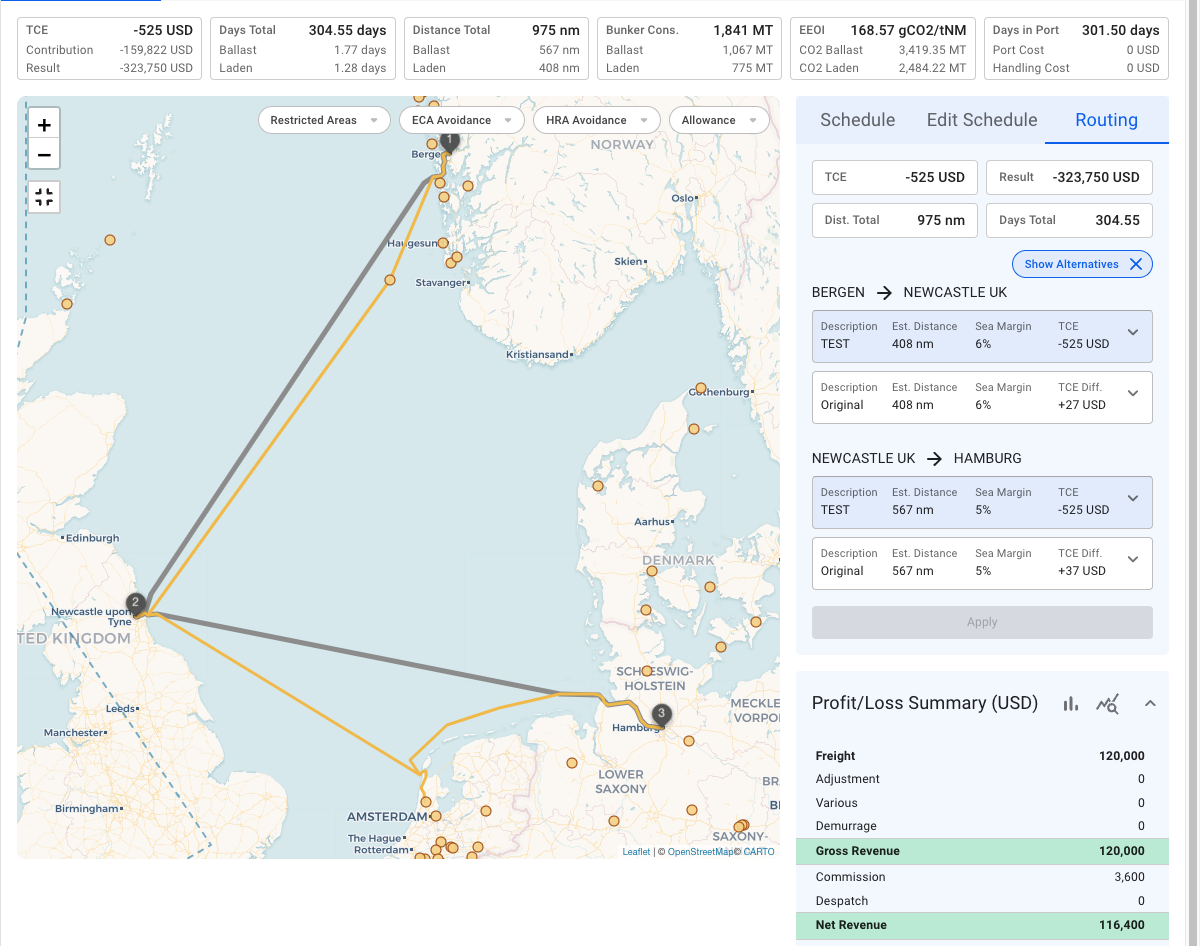
A voyage going from Bergen to Hamburg through Newcastle is displayed in *Figure 1*. The routing tab illustrates an alternative route for each leg. As presented in the screenshot, there is a key difference between the routes:
Figure 1. Schedule - Routing with alternative routes
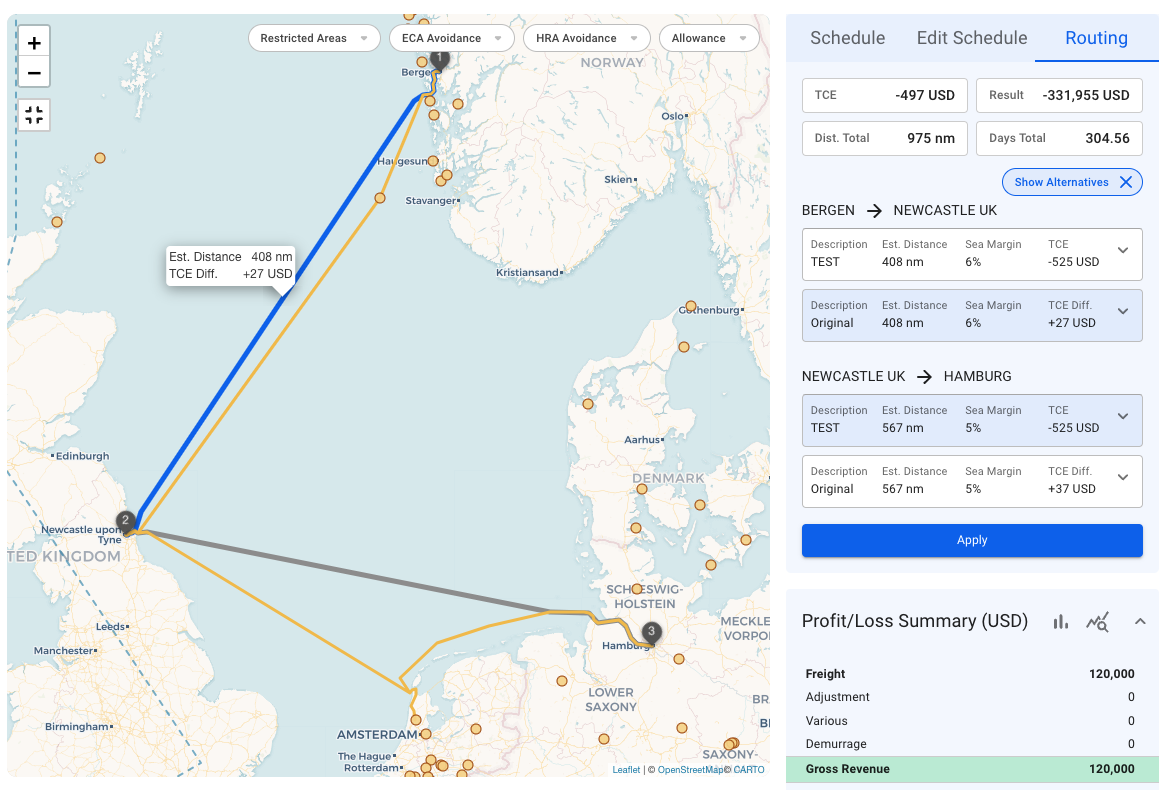
* *TCE Difference*: the TCE difference indicator shows the difference between the alternative route TCE and the currently selected route TCE. So, for the leg, Bergen -> Newcastle, the current TCE is -525 USD. On the other hand, selecting the alternative route will result in +27 USD, which is -497 USD of TCE total *(Figure 2)*.
Figure 2. Alternative route TCE Difference
### Detailed Comparison:
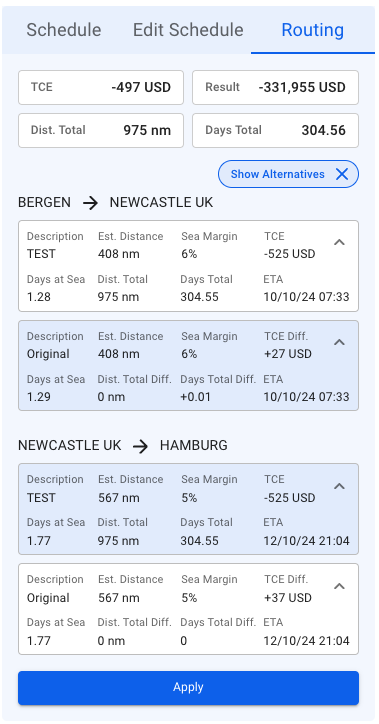
It is also possible to compare the routes in more detail! For instance, take a look at the screenshot below:
Figure 3. Routing - Detailed route comparison
Clicking the top-right arrow in each container expands the detailed information.
The *apply* button proceeds with the changes and saves the selected route for the current voyage.
---
# Agent Instructions
This documentation is published with GitBook. GitBook is the documentation platform designed so that both humans and AI agents can read, navigate, and reason over technical content effectively. Learn more at gitbook.com.
## Querying This Documentation
If you need additional information that is not directly available in this page, you can query the documentation dynamically by asking a question.
Perform an HTTP GET request on the following URL with the `ask` and `goal` query parameters:
```
GET https://docs.dataloy.com/release-8.31/voyage-management-system/step-by-step-guides/voyages/maintain-voyages/overview/schedule-routing.md?ask=&goal=
```
`ask` is the immediate question: it should be specific, self-contained, and written in natural language.
`goal` is what the user is ultimately trying to achieve, the reason they need the answer. Sharing it helps GitBook give you a better, more relevant answer. A goal is most helpful when it describes the outcome the user wants rather than restating the question. For example, with `ask=how do I create an API token`, a goal like `build a script that syncs our docs to a CMS` lets GitBook tailor the answer to that use case.
The response will contain a direct answer to the question and relevant excerpts and sources from the documentation.
Use this mechanism when the answer is not explicitly present in the current page, you need clarification or additional context, or you want to retrieve related documentation sections.