> For the complete documentation index, see [llms.txt](https://docs.dataloy.com/llms.txt). Markdown versions of documentation pages are available by appending `.md` to page URLs; this page is available as [Markdown](https://docs.dataloy.com/release-8.31/voyage-management-system/step-by-step-guides/setup/system-settings/webhooks-and-alerts.md).
# Webhooks and Alerts
### Overview
The **Webhooks & Alerts** system settings page lets administrators control which object types are eligible when a webhook subscription uses trigger mode **“All Object Types”**.
This is done by maintaining an **Exclude list** of object types that should **not** trigger webhooks when “All Object Types” is enabled.
### What the setting does
When a webhook subscription is configured with All Object Types, webhook notifications are triggered **only** for object types that are included.
Object types placed in the **Exclude** list will never trigger webhook notifications when using All Object Types.
This allows administrators to:
* Exclude noisy or irrelevant object types
* Avoid subscriptions failing due to unsupported or restricted objects
* Keep “All Object Types” usable and predictable
### Configuration
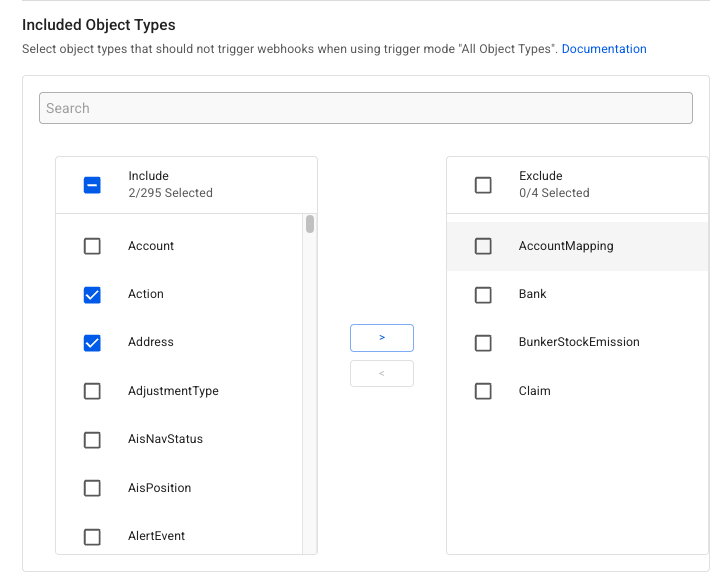
The page provides a transfer list:
* Move object types to **Exclude** to disable webhook triggering
* Move them back to **Include** to re-enable triggering
* A search field helps filter long lists
Changes are saved automatically and apply immediately.
###
---
# Agent Instructions
This documentation is published with GitBook. GitBook is the documentation platform designed so that both humans and AI agents can read, navigate, and reason over technical content effectively. Learn more at gitbook.com.
## Querying This Documentation
If you need additional information that is not directly available in this page, you can query the documentation dynamically by asking a question.
Perform an HTTP GET request on the following URL with the `ask` and `goal` query parameters:
```
GET https://docs.dataloy.com/release-8.31/voyage-management-system/step-by-step-guides/setup/system-settings/webhooks-and-alerts.md?ask=&goal=
```
`ask` is the immediate question: it should be specific, self-contained, and written in natural language.
`goal` is what the user is ultimately trying to achieve, the reason they need the answer. Sharing it helps GitBook give you a better, more relevant answer. A goal is most helpful when it describes the outcome the user wants rather than restating the question. For example, with `ask=how do I create an API token`, a goal like `build a script that syncs our docs to a CMS` lets GitBook tailor the answer to that use case.
The response will contain a direct answer to the question and relevant excerpts and sources from the documentation.
Use this mechanism when the answer is not explicitly present in the current page, you need clarification or additional context, or you want to retrieve related documentation sections.