# Create and Edit Duration and Rates

The Create/Edit Duration modal lets you specify details about a particular Duration and it's Rates.

## Create a Duration

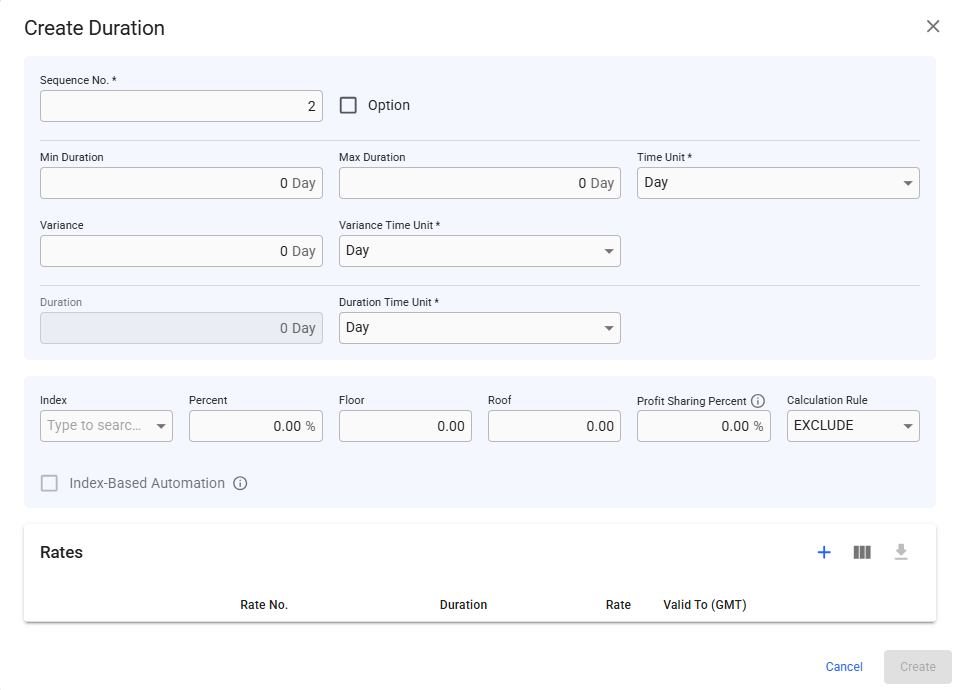
After clicking the ![](/files/6ZB8VA4TG2TBgiUunHbz)-icon, you will get this view:

<figure><img src="/files/oZG1ZELXd04cenwrj2BV" alt=""><figcaption><p>Create TC Duration Modal</p></figcaption></figure>

Here, you can add inn various values for both the TC's duration and the duration's rates. You can create TC rates at the bottom **Rate** table.&#x20;

When connecting a duration to a Market Index, you will automatically get the last updated date of it's Market Index Values in GMT:

<figure><img src="/files/m4rl6DsbeHH2TSiRVKjL" alt=""><figcaption><p>Connect TC Duration to a Market Index</p></figcaption></figure>

## Edit a Duration

As mentioned, by double-clicking on any of the fields per row, you can edit directly to the existing durations. You can also click on the <img src="/files/Fc7Sbf92RFeMJRAD4ADb" alt="" data-size="line">-icon to expand to display and edit some additional data per row:

<figure><img src="/files/baAh9uJnX72IlFgPcdL1" alt=""><figcaption><p>Expanded view of Durations list</p></figcaption></figure>

All below sections are collapsible.

### Duration Details section

Each Durations row lets you specify the duration time unit, length of the duration, by setting the minimum and maximum duration, as well as the variance. You can also tick off 'Option', which lets you select the Option Status, which marks the duration as Declared, Forfeited or Not Declared. These fields you can edit within the top-part of the **Duration Details** section as well.&#x20;

There, you can also decide the mix/max time unit, as well as the variance time unit.

In the bottom-part of the **Duration Details** section, the duration itself is calculated based on the rule selected in the Duration Length Rule dropdown menu, with the default rule being **Sum of all TC Rates**. You can select the duration's time unit as well. All of the units can be of type 'Day' or 'Month'.&#x20;

The <img src="/files/7nerA6r6H8b3uTuGrZwl" alt="" data-size="line">-icon per durations and/or duration's rates row lets you delete the selected row.&#x20;

#### Enable Time Automation

Also in the bottom-part of the **Duration Details** section, you can tick ON the **Time Automation** checkbox. This will enable the Default Rate Length selector, and the rule of Duration Length Rule will be defaulted to **Maximum Duration + Variance**. Then, the rates will be generated automatically within the Rate list at the right-side of this section. Changing the default rate length will delete all existing TC rates, and re-generate new ones based on the new value, along with the current rule. The current rule decides how duration is calculated, as mentioned in above paragraph. You can also change min/max and/or variance fields, which the duration and TC rates will update accordingly (this will not automatically impact the duration's time unit).&#x20;

E.g., take the below example; if time automation is enabled, the duration length rule will become Maximum Duration + Variance\*, which is here 20 days + 2 days = 22 days under duration. Since default rate length is now enabled, we can now override the defaulted 22 days, to e.g. 10 days:

<figure><img src="/files/WZLpORJpAfOzDI0MATM8" alt=""><figcaption><p>Duration Details section, Time Automation enabled</p></figcaption></figure>

As you can see, we have now generated 3 TC rates, which first and second ones have durations of 10 days each, and the remaining of 2 days in the third. Hence, the input of duration rate length decides how many rates are generated, until we reach the duration. Ticking it OFF will keep the rates as is, but you can change them or delete them however you like again.

If the number of rates exceeds the length of this right-side Rate list, then you will be able to scroll.&#x20;

\*You can override the rule even if it's defaulted at Maximum Duration + Variance.&#x20;

{% hint style="warning" %}
When enabling Time Automation, it will no longer be possible to create, delete or edit the sequence of the TC rates.
{% endhint %}

The Valid To date is based on:

* For TC Out contracts: the delivery port call's ATA date
* For TC In contracts: the voyage start date of the first linked voyage

### Risk section

Below this section, is the Risk section. Here, a selected TC Benchmark Index, of a TC duration, is mapped to a [Market Index](/release-8.25/voyage-management-system/step-by-step-guides/chartering/market-indices.md) to report and process the dimension:

<figure><img src="/files/S3w3ZEGaL5RZvOU29O8n" alt=""><figcaption><p>Risk section</p></figcaption></figure>

### Index-Based Rate section

Below this again, is the **Index-Based Rate** section, you can specify a particular Index ([Market Index](/release-8.25/voyage-management-system/step-by-step-guides/chartering/market-indices.md)) the TC rates should follow.

#### Enable **Index-Based Automation**&#x20;

After selecting an Index, when you tick ON the **Index-based Automation** checkbox, each of the **TC rates** in the duration will be automatically filled-in based on this index. Note that this will not generate any rates here to follow if you don't select an index first! You can use this feature regardless if Time Automation is turned ON or OFF. With a default rate length = 15, we for instance get the below for thid duration:

<figure><img src="/files/5sNUrSGc2J0g8H0zPNVE" alt=""><figcaption><p>Index-Based Rate section, Index-Based Rate and Time Automation enabled</p></figcaption></figure>

**Another example with Index-Based Rate**

NOTE: this is a screenshot from the old layout!

<figure><img src="/files/YE1jafTNDjGWrGDslFt0" alt=""><figcaption><p>Example, Index-Based Rate and Time Automation enabled</p></figcaption></figure>

Based on the linked Market Index's Values (MIV):

<figure><img src="/files/UyVKSsJMrUp5eBuhwsrM" alt=""><figcaption><p>Market Index Values of a Market Index</p></figcaption></figure>

In the example above TC rate 1 will use all the rates from 05/03/26 until and including 19/03/26. TC Rate 2 will use the SPOT rates from 20/03/26-25/03/26, then the 01/03/26-31/03/26 FORWARD rates for the remaining days in March, and finally the 01/04/26-30/04/26 FORWARD rates for the final 3 days (excludes the last date of the rate).

{% hint style="warning" %}
Note that:

* it's not possible to enable the Index-based Automation without choosing an Index first
* if Index-based Automation is enabled, it is not possible to remove the Index chosen
  {% endhint %}

You can also decide the Percent to count of the rates, you can also choose Floor and/or Roof for the rates to follow, as well as the Profit Sharing Percent.&#x20;

#### Select a Calculation Rule

{% hint style="warning" %}
These rules only affect dates from today and going backwards in time, i.e. SPOT values. However, any date that goes into the future will always use the **previously available** MIV when calculating the rate, i.e. FORWARD values.
{% endhint %}

As you saw in all above examples, you can choose a Calculation Rule; EXCLUDE, PREVIOUS or NEXT.

EXCLUDE: is the default selected rule. Calculates x days in average of published indices, **excluding** the days that are not registered in the system.&#x20;

&#x20;     **Note**: EXCLUDE follows the same logic as earlier implementations of TC rates.

PREVIOUS: calculates x days in average of published indices, using the latest available index for the **previous** index registered in the system.&#x20;

NEXT: calculates x days in average of published indices, using the latest available index for the **next** index registered in the system.&#x20;


---

# Agent Instructions: Querying This Documentation

If you need additional information that is not directly available in this page, you can query the documentation dynamically by asking a question.

Perform an HTTP GET request on the current page URL with the `ask` query parameter:

```
GET https://docs.dataloy.com/release-8.25/voyage-management-system/step-by-step-guides/chartering/time-charter-contracts/maintain-time-charter-contracts/duration-and-rates/create-and-edit-duration-and-rates.md?ask=<question>
```

The question should be specific, self-contained, and written in natural language.
The response will contain a direct answer to the question and relevant excerpts and sources from the documentation.

Use this mechanism when the answer is not explicitly present in the current page, you need clarification or additional context, or you want to retrieve related documentation sections.
