> For the complete documentation index, see [llms.txt](https://docs.dataloy.com/llms.txt). Markdown versions of documentation pages are available by appending `.md` to page URLs; this page is available as [Markdown](https://docs.dataloy.com/release-8.12/fleet-allocation-and-scheduling/getting-started/planning/budgets/data-grids-fas/exchange-rates-grid.md).

# Exchange Rates Grid

Budget-specific **exchange rates** can be found here:

<figure><img src="/files/U9rDPZzy123b7ekzTWOi" alt=""><figcaption><p>Exchange Rates grid</p></figcaption></figure>

Note that these will be specific "budget exchange rates".

All these rows are non-editable.

Read more about the grid's "base functionality" [here](/release-8.12/voyage-management-system/step-by-step-guides/data-grids.md#base-functionality).

## Creating an Exchange Rate

By clicking the <img src="/files/-M23aB95JDSUt7kYOdWo" alt="" data-size="line">-icon on the grid (not the top-most one), you will be able to *create* a new Exchange Rate, that is adapted to your needs. You can find it under the Master Data module as well. There, you will see the Budget Scenario name listed within the Budget Version column, to identify which exchange rates are of type "budget":
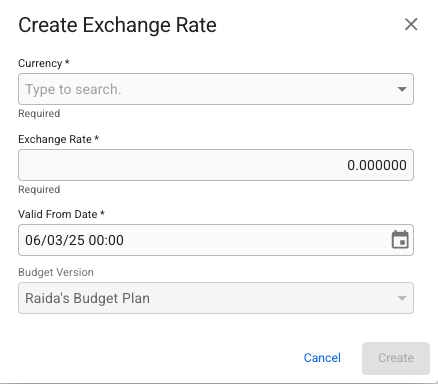
<figure><img src="/files/4AmYtPzyKRnMB2YBjxbq" alt=""><figcaption><p>Create Exchange Rate modal</p></figcaption></figure>

Note that you **cannot** edit the Budget Version as it's pre-selected from the Budgets view.&#x20;

## Opening an Exchange Rate

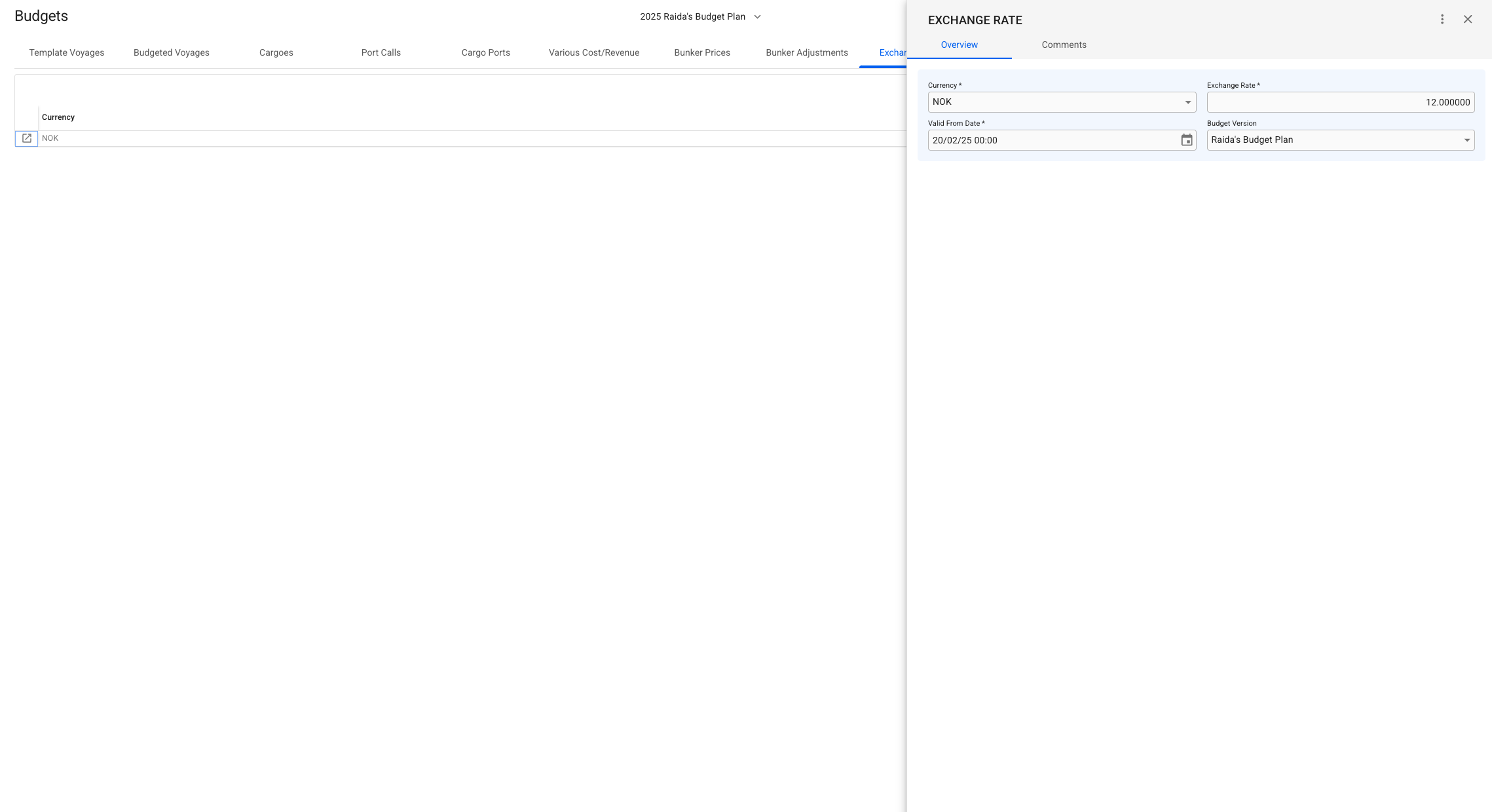
By clicking the ![](/files/9dhMV8Miz4HqKaqYn55w)-icon in the left-most column, you will be able to *open* up the Exchange Rate drawer for that specific row. From the below view, you can edit the selected exchange rate:

<figure><img src="/files/8dSXNOWbbi5Z0WhpHMBk" alt=""><figcaption><p>Exchange Rate drawer from Exchange Rates grid view</p></figcaption></figure>

Changes done in the drawer will be reflected in the rows.&#x20;

Additionally, you can also use the secondary actions ![](/files/MrweRu0oJHAlW3EZRXf1) to **disable** the exchange rate.


---

# Agent Instructions
This documentation is published with GitBook. GitBook is the documentation platform designed so that both humans and AI agents can read, navigate, and reason over technical content effectively. Learn more at gitbook.com.

## Querying This Documentation
If you need additional information that is not directly available in this page, you can query the documentation dynamically by asking a question.

Perform an HTTP GET request on the current page URL with the `ask` query parameter, and the optional `goal` query parameter:

```
GET https://docs.dataloy.com/release-8.12/fleet-allocation-and-scheduling/getting-started/planning/budgets/data-grids-fas/exchange-rates-grid.md?ask=<question>&goal=<endgoal>
```

`ask` is the immediate question: it should be specific, self-contained, and written in natural language.
`goal` is optional and describes the broader end goal you are ultimately trying to accomplish on behalf of the user. GitBook uses it to tailor the answer towards what is most useful for that goal.

The response will contain a direct answer to the question and relevant excerpts and sources from the documentation.

Use this mechanism when the answer is not explicitly present in the current page, you need clarification or additional context, or you want to retrieve related documentation sections.